

News
No matter how hard you train your core, it’s not working? The key lies in the frequency of vibration training and pelvic posture!
Here is the accurate, professional, natural English translation for your fitness/rehabilitation marketing copy:
People in the fitness community often complain: After training their core for a long time, their stability is still poor, and muscle activation is barely noticeable? Actually, it is not that you are not working hard enough, but that you have not found the fundamental logic of training.
Today, Whole-Body Vibration (WBV) training is no longer exclusive to rehabilitation departments. It has become a powerful core training tool for fitness enthusiasts and sports rehabilitation lovers. By stimulating neuromuscular function through mechanical vibration, it efficiently activates muscle groups and improves core stability.
But do you know? Even when standing on the same vibration platform, correct pelvic alignment and appropriate vibration frequency can make a tremendous difference in muscle activation!
A classic study from the Catholic University of Korea reveals the answer. Published in the Journal of Physical Therapy Science, this research specifically investigated the effects of pelvic position and vibration frequency on core and related muscle activation during quiet standing.
The electromyographic (EMG) data from 18 healthy subjects provided the most intuitive scientific conclusions, making it a guide to avoiding mistakes in vibration training.
The research team set three common vibration frequencies (0 Hz, no vibration; 10 Hz; 20 Hz) and three pelvic postures (neutral, anterior tilt, posterior tilt). They monitored EMG activity in 8 muscles closely related to postural stability, including the upper trapezius, erector spinae, rectus abdominis, external oblique, and gluteus maximus.
The results overturned many people’s preconceptions:
The activation level of all monitored muscles differed significantly under different frequencies and pelvic postures.
Choosing the right combination can double your training effects!
Choose a higher frequency over a lower one — 20Hz is the golden activation frequency for most muscles.

The study found a significant positive correlation between neuromuscular activation and vibration frequency: the higher the frequency, the stronger the induced electromyographic activity. This is highly consistent with the findings of Pollock et al.
With the exception of no significant differences for the rectus abdominis between 0–10 Hz, and for the external oblique and semitendinosus between 10–20 Hz, all other muscles showed marked increases in activation when comparing 0–10 Hz, 0–20 Hz, and 10–20 Hz.
In particular, 20 Hz high‑frequency vibration drove electromyographic activity in core and lower‑limb muscles — including the erector spinae, gluteus maximus, and rectus femoris — to peak levels, far exceeding those at 10 Hz and in the non‑vibration condition.
In short: if you want to strengthen your core and activate lower‑limb muscles via vibration training, stop experimenting with low frequencies.
20 Hz high‑frequency vibration is the more efficient choice, maximizing motor unit recruitment and delivering stronger contractile stimulation to the muscles.
Pelvic Posterior Tilt: The “Game-Changing Posture” for Core Activation
These Muscles Benefit the Most
If frequency is the “accelerator” of vibration training, then pelvic position is the “steering wheel.” Only with the correct posture can stimulation be precisely targeted to the desired muscle groups.
The study was the first to clearly identify the critical influence of pelvic position on muscle activation during vibration training, with pelvic posterior tilt yielding particularly outstanding results:
Activation of the external oblique muscle differed significantly between neutral and posterior tilt positions.
Gluteus maximus activation showed highly significant improvements in both neutral-to-posterior tilt and anterior-to-posterior tilt comparisons.
When combining 20Hz vibration + pelvic posterior tilt, rectus abdominis electromyographic activity reached its peak level.
In contrast, pelvic anterior tilt preferentially activates the erector spinae. These back extensor muscles exhibit far greater contraction in anterior tilt than in neutral or posterior tilt positions.
This also confirms the theory of musculoskeletal kinesiology:
During pelvic posterior tilt, the force-couple system formed by the gluteus maximus (hip extensor) and abdominal muscles is fully engaged—these are the key muscles responsible for core stability!
These research findings will revolutionize your understanding of vibration training.
Core muscles are activated more fully than distal muscles
Unlike previous conclusions that “muscles closer to the vibration plate are activated more strongly,” this study discovered that during static standing vibration training, the core muscles near the trunk (rectus abdominis, external oblique, erector spinae, gluteus maximus) are activated more sufficiently.
This indicates that proper pelvic alignment allows vibration energy to be transmitted more precisely to the core, rather than only affecting the distal leg muscles.
The combination of posture and frequency is the key
There is no universal “single parameter.”
To train the gluteus maximus + external oblique, choose 20 Hz + pelvic posterior tilt.
To strengthen the erector spinae, use 10–20 Hz + pelvic anterior tilt.
Targeted combinations lead to more efficient training.
Vibration training is both safe and effective
The study also confirmed that whole-body vibration training is friendly for people with muscle weakness and poor core stability.
It does not impose excessive stress, yet efficiently activates neuromuscular function through mechanical stimulation, making it an ideal approach for both rehabilitation and fitness improvement.

Scientific Vibration Training Practical Guide:Maximize Your Core Training with Yufeng Medical Vibration Training System
Combining the above research findings with the Yufeng Medical Vibration Training System—specially designed for medical and sports applications—can maximize the effectiveness of vibration training.
Based on human walking gait mechanics, this system features a unique left-right alternating tilt motion mode that precisely matches training requirements for different pelvic postures. It also allows flexible adjustment of frequency and amplitude, balancing safety and training efficiency.
Suitable for diverse settings including homes and medical institutions, the system provides customized training programs for various user groups.
Practical application recommendations are as follows:
Top Choice for Core Strengthening:20–30 Hz High Frequency + Pelvic Posterior Tilt
Suitable for all series of vibration training devices.
Select the Yufeng Medical Vibration Trainer – either the integrated model or the separate model.
Set the frequency to the 20–30 Hz muscle strength training range, and adjust the amplitude from 0–4.5 mm according to your personal tolerance.
Maintain a pelvic posterior tilt posture, bear weight evenly on both feet, and look straight ahead.
At this frequency, muscles undergo continuous contraction. Combined with the device’s left-right alternating tilting pelvic motion mode, it can precisely activate the rectus abdominis, external oblique, and gluteus maximus, efficiently improving stability of the lumbo-pelvic-hip complex.
Back Extensor Strengthening: 12–20 Hz Functional Training + Pelvic Anterior Tilt
Ideal for Professional Models
Choose either the Integrated Vibration Trainer or the Separate Professional Medical Vibration Trainer.
Set the frequency to 12–20 Hz, the optimal range for muscular functional training, allowing muscles to complete a full contraction‑relaxation cycle.
Combined with a pelvic anterior tilt posture, this setup targets and activates the erector spinae while improving intermuscular coordination.
It is suitable for those who wish to strengthen their back muscles and improve posture.
The separate model features a wide vibration platform and curved safety handrails, helping users maintain proper training posture and enhancing safety during exercise.

Exclusive for Special Populations: Customized Equipment + Personalized Frequency & Posture for Both Training and Rehabilitation
For adults/children unable to stand independently:
Use the Y‑V4 for Adults and Y‑V5 for Children tilting bed vibration trainers. Adjust the tilt angle of the lifting bed from 0–90°, and control the vibration frequency via remote control.
Under medical guidance, pelvic neutral position is recommended as the primary posture. Start with a low frequency of 5–12 Hz to improve balance and flexibility first, then gradually increase as tolerated.

For postoperative / bedridden patients:
Use the Yufeng Vibration Hospital Bed. Without the need to actively get up, vibration stimulation enhances proprioception, while activating the pelvic floor muscles and core muscles. This helps prevent muscle atrophy and thrombosis, promotes gastrointestinal peristalsis, and improves issues caused by bed rest such as constipation and urinary retention.

For those requiring upper limb + core coordinated training:
Use with the Y-L2 Medical Upper Limb Vibration Rehabilitation Trainer (5–40 Hz wide frequency adjustment).
Upper limb training can be combined with core vibration training from the main device to achieve full-body muscle activation.

Precise Pelvic Correction:3D Pelvic Correction & Restoration System — All-in-One from Evaluation to Training
For those with pelvic dysfunction, rectus abdominis diastasis, pelvic floor muscle weakness, and other conditions:
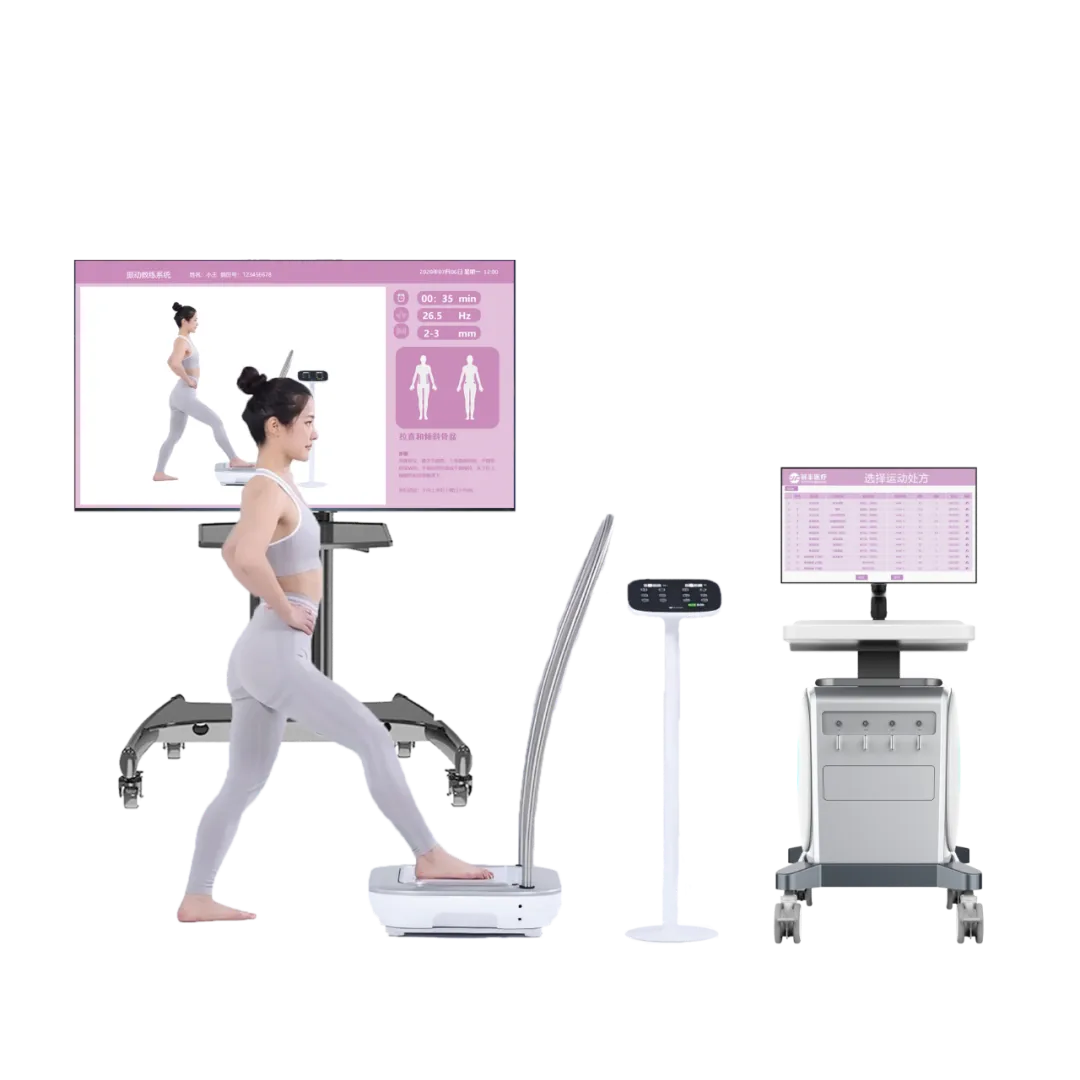
Start with a professional evaluation using the 3D Pelvic Correction & Restoration System, which accurately assesses the condition of the pelvis, pelvic floor muscles, and rectus abdominis.
Based on the results, the system generates a customized exercise prescription, combining targeted postures such as pelvic posterior tilt/anterior tilt with dedicated vibration frequency and amplitude.
During training, video animations and voice guidance ensure standard movement form.
After training, a printable report is available to track progress and effectiveness.
This system is especially suitable for women’s rehabilitation and postnatal pelvic restoration.
Nowadays, more and more people value scientific fitness and reject random, unguided training. This research serves as an important reminder: the effectiveness of any exercise relies on precise control of body mechanics and training parameters.
The vibration training system by Yufeng Medical has been clinically verified. During training, the forces acting on the head, hips, knees, and legs, as well as the ground reaction forces, are significantly lower than those during daily activities such as standing, walking, and jumping. It balances safety and effectiveness and has been widely adopted by numerous medical institutions and professional universities, making it an excellent choice for rehabilitation and fitness enhancement.
Of course, training should be individualized. If you have musculoskeletal injuries or special rehabilitation needs, it is recommended to adjust equipment parameters and training postures under the guidance of a professional physical therapist.