未分类
Stop Being Misled! For Posture Problems, Assess First, Then Train—It’s More Effective Than Random Workouts a Hundred Times Over
We often receive messages from followers on the backend:”Working in the office for long hours makes my slouching worse and worse, and I look frumpy in clothes.””Looking down at my phone all the time leaves my neck sore and stiff, and people always say I ‘look listless’.””I followed the trend and tried those viral stretching routines, but instead of fixing my uneven shoulders, they just made my shoulder pain worse.”……
Watching their own misaligned postures, many adults are eager to correct them but often take detours through blind attempts — either ending up with more pain after training, seeing only fleeting correction effects, or even worsening their postural problems, which further impacts their daily work and life.
Today we’re going to spell out the core logic of posture correction: Assess first, then train. Blind training that fails to identify the root cause is not as effective as one session of targeted training, even if you repeat it a hundred times!
Why Is Blind Training Useless? Instead, Why Does It Cause More Injuries?

Many adults correct their posture purely based on “visual judgment” and “following trends based on others’ experience”, yet they overlook the crucial scientific logic: poor posture in adults is essentially “muscle strength imbalance caused by long-term poor postures” or “compensatory posture resulting from chronic strain”. Correction plans vary completely depending on the underlying causes, and blind training will only be counterproductive.
From the perspective of sports rehabilitation medicine, postural stability relies on the balanced activation of core muscle groups. It is similar to a house—only when the load-bearing walls and supporting structures bear force evenly can the house remain stable. After long-term “conditioning” by fixed postures, adults’ muscle groups tend to fall into an imbalanced state of “over-tension in some parts and excessive weakness in others”, which in turn leads to postural collapse.
Take hunchback for example—the underlying causes can be vastly different:
Some cases are upper cross syndrome—long-term head-down postures cause over-tension in the pectoralis muscles and upper trapezius, while the rhomboids and middle trapezius become weak, which is a typical muscle imbalance issue.
Others are thoracic kyphosis triggered by prolonged sitting, which belongs to compensatory spinal deformation.
There are also cases of compensatory hunchback resulting from chronic cervical strain.
Similarly, uneven shoulders can be of two types:
The unilateral muscle tension type (caused by long-term one-shoulder bag carrying or unilateral force application).
The secondary spinal rotation type—long-term poor postures lead to axial rotation of the spine, pulling the shoulders into an uneven position. For such structural problems, superficial stretching alone is completely ineffective.
More importantly, adults’ muscles and bones are basically fully developed and stabilized. Postural problems are highly stubborn but can be improved through scientific intervention. Only by identifying the root causes can we achieve targeted correction and avoid futile efforts.

Rehabilitation physicians explicitly warn: Postural problems in adults are mostly accompanied by chronic strain, and the risks of blind training are mainly concentrated in “aggravating existing strain” and “causing new injuries”—
Forcing oneself to stand against a wall: This only temporarily corrects superficial posture and fails to address the root cause of muscle imbalance; once you step away from the wall, your posture reverts immediately. Worse still, if you already suffer from chronic cervical or lumbar strain, forcing yourself to stand against the wall may exacerbate uneven stress on the spine and trigger increased pain.
Misusing posture correctors: Forcible binding can compress the thoracic cage and impair smooth breathing. Meanwhile, external rigid fixation may lead to disuse atrophy of muscles, gradually weakening their ability to contract voluntarily. This forms a vicious cycle where “you stand tall only with the corrector on, and your posture rebounds as soon as you take it off”.
Blind stretching/exercising: Failing to target the tight muscle groups may instead strain the muscles and ligaments in the already damaged areas. If there is underlying spinal rotation, incorrect exercises may worsen the degree of spinal rotation, and even induce serious problems such as intervertebral disc herniation.
Citing relevant data from Guidelines for the Prevention and Treatment of Chronic Musculoskeletal Pain in Chinese Adults: The incidence of poor posture among adults in China is as high as 78%, and nearly 70% of them have aggravated their postural problems due to blind correction, and even induced cervical and lumbar diseases.

The first step in posture correction is not “training”, but “assessment” — only by identifying the root cause of the problem through professional evaluation can we carry out targeted training.
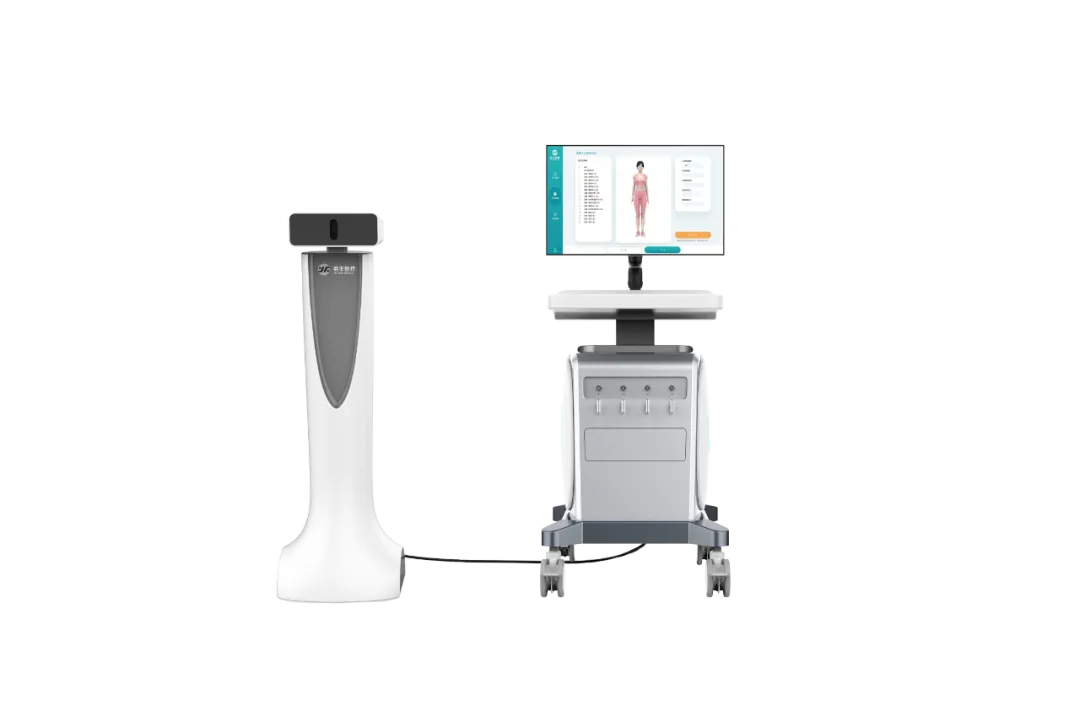
Based on the core concepts of holistic health and preventive medicine, the Intelligent Posture Analysis System relies on a million-level health database, integrates artificial intelligence, cloud computing and big data technologies, and combines the principles of sports biomechanics, ergonomics and clinical medicine. It is an all-around physical assessment tool integrating measurement, evaluation, screening and customer management. The system is empowered by four core modules:
Posture Assessment: Accurately identifies bony landmarks to conduct a comprehensive evaluation of the head and neck, shoulders, pelvis, lower limbs, etc.
Spinal Screening: Adopts the Adam’s forward bend test to accurately measure the ATR angle of the thoracic/lumbar segments, and efficiently screens for the risk of scoliosis.
Joint Assessment: Provides full-coverage, multi-dimensional detection of active range of motion (ROM).
Scale Assessment: Embeds commonly used clinical scales, conducts a comprehensive analysis combined with objective data, and delivers results more suitable for medical scenarios.

Versatile Application Scenarios
It covers a wide range of institutions both inside hospitals (such as postpartum rehabilitation departments, adolescent posture management clinics, etc.) and outside hospitals. It integrates comprehensive functions including posture testing, Adam’s test, joint range of motion (ROM) detection, and scale assessment.
High Efficiency, Stability & Accuracy
The high-precision dynamic rotating platform with environment-adaptive calibration ensures higher efficiency and accuracy.
Multi-dimensional Assessment
It collects multi-dimensional data to provide comprehensive physical measurement results, and accurately evaluates potential health risks in an all-round way.
Intuitive & Easy to Understand
Assessment results are presented in the form of visualized charts, enabling users to intuitively understand their own posture problems.
Scientific & Flexible
It supports manual correction of automatically identified bony key points, thus ensuring the accuracy and personalization of tests.
Precise Data
Relying on large user data samples, the detection system generates high-quality analysis results through advanced intelligent algorithms.
Scientific Training: Targeted Correction, 10 Times More Efficient Than Blind Workouts
Once the root cause of the problem is identified, the next step is targeted training. Here it is important to emphasize that the core of adult posture training lies in gentle relaxation plus precise activation, rather than high-intensity exercise.


Sitting-related Hunchback: First Assess Whether It Is “Muscle-induced” or “Compensatory”
Most cases of hunchback in adults are associated with prolonged sitting and head-down postures, but the core causes fall into two categories: one is muscle imbalance-induced, which is also the most common type among office workers; the other is cervical compensatory, mostly triggered by long-term cervical strain. During assessment, it will be found that the physiological curvature of the cervical spine becomes straightened, accompanied by tension in the upper back muscles. For this type, the training priority should be given to cervical relaxation first, followed by adjusting the muscle balance of the back.
If you directly practice “chest-opening” exercises without prior assessment, it may bring slight relief for muscle imbalance-induced hunchback. However, for cervical compensatory hunchback, it may instead increase the load on the cervical spine and aggravate neck pain. Only by clarifying the type through assessment can we determine the sequence and key direction of training.
Uneven Shoulders: The Key to Assessment Is to Check “Whether It Is Accompanied by Spinal Problems”
Uneven shoulders are another prevalent postural issue in adults. The core of assessment is to distinguish between simple muscle-induced type and spine-related type. The simple muscle-induced type is mostly caused by long-term one-shoulder bag carrying or propping the head on one side during work. Assessment shows that the height difference between the two shoulders is more than 1 cm, but the spinal midline has no deviation, and the tense muscles are concentrated in the trapezius muscle on the lower shoulder side. On the other hand, the spine-related type is caused by spinal rotation and mild scoliosis. Assessment reveals not only uneven shoulder height but also deviation of the spinal midline. For such cases, mere muscle relaxation cannot address the root cause; it is necessary to adjust the spinal force line through targeted training under the guidance of assessment.
This explains why many people still see no improvement in their uneven shoulders despite long-term stretching—essentially, they fail to identify the root cause through assessment and mistakenly treat spine-related uneven shoulders as a simple muscle problem. When the direction is wrong, no amount of effort will work.
It is evident that the key to adult posture correction has never been “which exercises to do”, but “to first clarify the direction of training”. The core function of the Posture Assessment System is to help people complete screening at home, clarify the type and root cause of their postural problems. The Vibration Trainer, on the other hand, provides support for scientific training. Its high-frequency vibration feature can more efficiently achieve the goal of “relaxing tense muscle groups and activating weak ones”, which is more labor-saving and precise than traditional manual massage and simple stretching. The combination of the two truly realizes a scientific correction closed loop of “assessment defines direction, training delivers results”.
The Earlier the Intervention, the Better
Although there is no strict “golden period” for adult posture problems, mild issues (such as muscle imbalance-induced hunchback) can be significantly improved within 4–8 weeks. If left untreated and developing into chronic strain, the correction cycle will be greatly prolonged.
Regular Reassessment Is Critical
It is recommended to conduct a test with the posture assessment system once a week to generate a posture change curve. Adjust the training plan in a timely manner to avoid recurring problems.
Reject a “One-size-fits-all” Approach
Every adult’s posture problems are related to their occupation and daily postures. Training must be based on assessment reports and combined with habit adjustments. Only by addressing both aspects can we prevent rebound.
Finally, we want to say: Adult posture correction cannot be rushed or done blindly. Instead of wasting time and energy on random training, it is better to conduct a thorough assessment first and take targeted measures after identifying the root cause.
Yufeng Products